

The rules changed on 1 May 2026. The Central Bank of Nigeria instructed all International Money Transfer Operators (IMTOs), including Western Union, MoneyGram, Remitly and other licensed operators, to pay out remittances only in naira, at the official rate set by the Bloomberg BMatch rate.
The Bloomberg BMatch rate is the foreign exchange (FX) spot rate generated on BMatch, Bloomberg’s electronic trade-matching system. No dollar payouts. No recipient choice. For millions of Nigerians abroad, this was more than a regulatory update. It changed how they support their families back home.
Nigeria is one of Africa’s largest remittance destinations. Diaspora inflows reached $21.8 billion in 2025, supporting millions of households across the country. For some families, the new rule barely meant anything, because they were already receiving naira. Others felt it immediately. It removed something they valued deeply: the ability to receive and hold dollars before deciding when to convert.
In the weeks that followed, a familiar conversation began appearing in WhatsApp groups, Facebook communities and diaspora circles stretching from Manchester to Houston and Toronto. People were asking the same question: How are Nigerians abroad sending money home now? They wanted to know how to send money to Nigeria in 2026.
Many people who had quietly been using crypto remittances for a long time already knew the answer. Not for speculation or trading, but simply as a faster and more flexible way to move value across borders. This article shows the case of three Nigerians abroad who made that transition.
Since 1 May 2026, licensed money transfer operators must pay remittances to Nigeria in naira at the official rate. So many Nigerians abroad now send dollar stablecoins instead — USDT on the TRC20 network, or USDC from Canada. Family receives it in the Swapto app, converts it to naira, and gets paid into a Nigerian bank account within minutes.
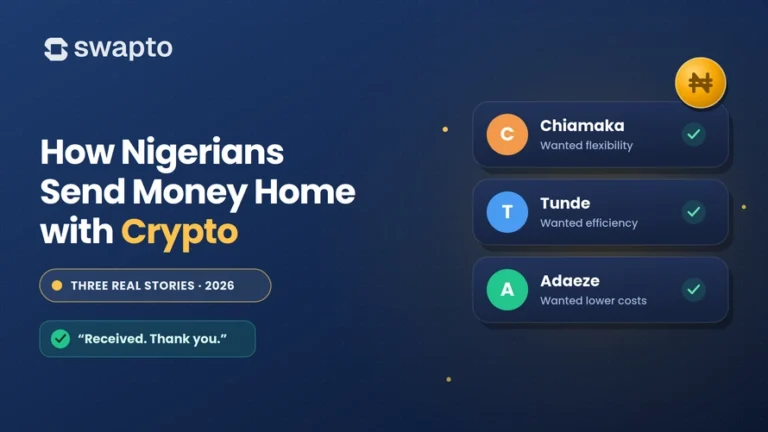
First is Chiamaka in Manchester, who sends money to her mother in Onitsha. Then Tunde in Houston, who supports a family business in Lagos. Then Adaeze in Toronto, who funds her brother’s education and a building project in Aba. Their stories and needs are different. Their transfer sizes are very different. Yet all three arrived at the same destination: sending dollar stablecoins from abroad and having family members in Nigeria convert them to naira through the Swapto app. We’ll show you how they do it as you read on.
Why This Article Exists Now: The May 2026 CBN Policy Change
The May 2026 directive fundamentally changed how licensed money transfer operators handle remittances into Nigeria. Under the new framework, recipients can no longer collect foreign currency directly from IMTOs. Funds must be settled in naira using the official Bloomberg BMatch exchange rate.
For many diaspora senders, the issue wasn’t simply exchange rates. It was flexibility. Previously, some families preferred receiving dollars, holding them for a while, and deciding when to convert. That option disappeared through official remittance channels. Diaspora crypto remittances, particularly USDT transfers, became increasingly relevant because they still let recipients receive dollar-pegged value and decide when to convert it into naira. Not much has changed for the family, except that they no longer hold physical dollar notes.
Importantly, this is not a loophole. Cryptocurrency operates through a separate framework from IMTO remittances, and crypto activity in Nigeria now sits within the country’s evolving regulatory environment under the Investments and Securities Act 2025.
Chiamaka’s Story: Manchester to Onitsha, £200 Every Month
The Background
Chiamaka, who is 34, moved to Manchester in 2019 to pursue a master’s degree. What was supposed to be a temporary move became permanent after she secured employment and built a life in the UK. Back home, her mother remained in Onitsha. Unfailingly, Chiamaka sends about £200 home every month. The money covers groceries, electricity bills, transportation, and the countless everyday expenses that rarely make it into family conversations.
For years, Western Union handled those transfers. Fees varied between £3 and £8 per transfer, and the exchange rate was 3 to 4% below the real market. As long as the process worked and the money got to the right place, that was enough. She never spent much time calculating the real cost. The money arrived, her mother was happy, and life continued.
The Shift
In 2024, a cousin introduced her to Wise. The fees dropped noticeably, to about £1 per transfer, and the exchange rates were more transparent. For a £200 transfer the savings weren’t dramatic: about £6 to £8 a month, or roughly £80 a year. Then came the May 2026 policy change. Chiamaka’s mother had sometimes preferred receiving value she could hold before converting. That flexibility disappeared.
Curious, Chiamaka spent a Saturday afternoon researching “diaspora crypto remittances Nigeria”. She watched several TikTok and YouTube videos, read articles, and asked questions. Then she decided to give it a try.
The Workflow
Today, her new method is remarkably fast and simple. She buys USDT on her preferred exchange, and her mother’s Swapto wallet address is already saved on her phone. She copies the address and sends the USDT on the TRC20 network, where the withdrawal fee is as low as about $1. Within minutes, the funds appear in her mother’s wallet.
Her mother opens Swapto, taps Sell USDT, and sees the naira amount upfront. After she confirms, the naira goes straight to her bank account. Shortly afterward, Chiamaka receives the same WhatsApp message she always gets after sending money to her mum: “Received my dear, thanks and God bless you.”
The Math
Interestingly, Chiamaka discovered that crypto was not dramatically cheaper than Wise for transfers of this size. That surprised her.
The real benefit was elsewhere: speed, flexibility, control. Her mother could receive value within minutes and choose when to convert it. For Chiamaka, that autonomy mattered more than a few extra pounds saved each year.
What Chiamaka Learned
In Chiamaka’s words: “My mother is not a tech person. She’s a retired teacher. I assumed crypto would be too complicated. It turned out the difficult part wasn’t the technology. It was simply deciding to try something new.”
Want to set this up for your family? Forward the Swapto app link to them and let them create a wallet before your first test transfer.
Tunde’s Story: Houston to Lagos, Running a Family Business from 8,000 Kilometres Away
The Background
Tunde, whose parents are in Lagos, moved to Houston in 2014 for an oil and gas role. His younger sister manages the family’s logistics business. Some months the business needs nothing. Other months it needs urgent cash for repairs, diesel, maintenance or unexpected expenses. Tunde’s transfers typically range from $1,000 to $3,000.
At first, he relied on a mix of wire transfers and Remitly. Wire transfers cost up to $35 each and took 3 to 5 business days. Remitly Express took minutes but ate 2.5 to 3.7% in FX markup. Both worked. Neither felt efficient.
The Shift
When Nigeria reopened banking relationships with crypto-related businesses in late 2023, Tunde began paying attention. Not because he was interested in trading crypto, but because he was interested in anything that made his payments more efficient. He started with a small test transfer of just $200.
He didn’t do anything strange or spectacular, and the funds arrived successfully. He doubted the system at first, so he tried again, and got the same result. Within months, crypto became his default method, especially for larger amounts. By May 2026, he had not used a wire transfer in 18 months, so the CBN’s naira-only rule didn’t touch him. He was already on a payout route that still gave him and his family a choice.
The Workflow
Every Sunday evening, he follows the same routine. He buys USDT on Kraken, one of the US exchanges that lets you withdraw USDT on the TRC20 network, and sends it for a withdrawal fee of a dollar or two. His sister receives it in her Swapto wallet and converts it to naira. The funds land in the family business account, and the whole cycle often finishes before bedtime in Houston. Mechanics, suppliers and drivers in Lagos get paid the same day. It is a completely different system from the way he used to send money.
The Math at His Scale
On a typical month sending $2,000, Tunde compares routes mentally:
- Wire transfer: $35 wire fee plus roughly 3% FX markup at the receiving Nigerian bank. Total cost: about $95, and it takes 3 to 5 days.
- Remitly Express: $3.99 fee plus 2.5 to 3.7% FX markup. Total cost: about $54 to $78, delivered within minutes.
- Crypto route: about $5 in Kraken trading fees, about $2 to withdraw on TRC20, and a 1% Swapto spread ($20). Total cost: about $27, done in minutes.
Compared with the mix of wires and Remitly he used before, Tunde saves about $600 a year at $2,000 a month. That’s money that would otherwise have gone into wire fees and FX margins. If $600 sounds like a small loss, think about this: over the eight years he expects to keep supporting the business, it adds up to roughly $5,000. That’s a new set of tyres for one of the business’s trucks, or half a year of his daughter’s school fees in Houston.
What Tunde Learned
“The wire transfer wasn’t expensive per transfer. It was expensive cumulatively. The crypto route saves me about $600 a year at this volume. At $5,000 a month, the same maths saves roughly $1,400 a year. At $10,000 a month, it’s about $2,600.” The larger the transfer volume, the more attention the fees and exchange-rate margins deserve.
Adaeze’s Story: Toronto to Aba, Sending Bigger Money with Higher Stakes
The Background
Adaeze, a healthcare administrator, has been in Toronto since 2016. She supports her younger brother Chinedu’s education. She also bought land in Aba and began building a modest retirement property. Unlike Chiamaka’s monthly support transfers, Adaeze often needs to send several thousand dollars at a time. She sends $3,000 to $5,000 home every quarter for the construction, plus about $800 a month for Chinedu’s expenses.
Larger amounts amplify everything. The fees that felt manageable on $300 transfers become punishing at $5,000. Her old method, a bank wire from RBC to her contractor’s GTBank account, cost $45 per wire and took up to 7 business days. The exchange rate at the Nigerian end was usually 3.5% below market. On a $5,000 transfer, she was losing about $220 to fees and FX. Imagine what that looks like when you’re sending four times a year, plus monthly amounts.
The Shift
She first used Wise for smaller payments, and it worked well. But the larger project transfers still went through traditional banking channels. The fees felt painful, and the waiting felt worse. In early 2025, her contractor’s son, a 26-year-old in Aba, suggested she try sending stablecoins. He was already a Swapto user from his freelance work. He agreed to receive payments on her behalf and pass the naira to his father. They tested with $500. The naira arrived in 19 minutes. Adaeze wept for joy.
The Workflow at Larger Amounts
Canadian exchanges no longer list USDT, so Adaeze uses its closest cousin, USDC, another dollar stablecoin. She buys $5,000 of USDC on Newton, a registered Canadian platform, paying about 1% ($50) in fees. She sends it to her contractor’s son’s Swapto wallet on a network Swapto supports. He sells it for naira in the Swapto app, the naira lands in his Nigerian bank account, and he transfers it to his father in less than 10 minutes. Construction payments that once took a week can now be completed the same day.
The Math at Her Scale
For a $5,000 construction payment, the crypto route costs her about $100: $50 in Newton fees, a network fee of about $1 on a low-fee network, and a 1% Swapto spread of about $50. The wire transfer used to cost her about $220: a $45 wire fee plus $175 lost to the 3.5% FX gap. That’s a saving of about $120 per transfer.
Across four construction payments a year, that’s about $480. Add the $800 she sends each month for Chinedu, compared with wiring it, and the crypto route saves Adaeze roughly $1,100 a year in fees and FX markups. On top of that come the time saved (minutes instead of days) and the certainty that the funds arrived, without calling her bank. Adaeze has not sent a wire transfer in 14 months.
What Adaeze Learned
In Adaeze’s words: “The bigger the amount, the more fees matter. Small fees become large fees when you’re sending thousands of dollars repeatedly.”
Sending larger amounts changes the maths significantly. Instead of rushing to make the payment, slow down and calculate the full cost of each remittance route before deciding which one works best for your situation.
NB: The fees and rates in these stories are approximate and change often. Check each provider’s current pricing before you send, and see today’s USDT to naira rate on Swapto or a tracker like Monierate.
The Common Thread Across All Three Stories
| Chiamaka | Tunde | Adaeze | |
|---|---|---|---|
| Route | Manchester to Onitsha | Houston to Lagos | Toronto to Aba |
| Typical transfer | £200 a month | $2,000 a month | $5,000 a quarter |
| Old cost per transfer | About the same as crypto (Wise) | About $95 (wire) or $54 to $78 (Remitly Express) | About $220 (wire) |
| Crypto route cost | Small fees, much faster | About $27 | About $100 |
| What they gained | Flexibility for her mother | About $600 a year | About $1,100 a year |
Although their circumstances differ, all three stories share several important patterns:
- They send dollar stablecoins rather than volatile cryptocurrencies like BTC or ETH: USDT from the UK and US, and USDC from Canada, where registered exchanges no longer list USDT.
- Chiamaka and Tunde send USDT on the TRC20 network because of its low transfer costs.
- Their recipients convert the funds to naira using Swapto, a Nigerian off-ramp that operates within Nigeria’s regulatory framework through a licensed partner, with naira paid to the recipient’s bank in minutes.
- They all started with small test transfers ($500 or less) before sending larger amounts.
- The recipient’s experience mattered just as much as the sender’s. None of these stories would work if the Nigerian recipient couldn’t figure out the app. In all three cases, the recipient found Swapto easy to use.
Most importantly, none of them switched because they were crypto enthusiasts. They switched because a problem needed solving: a delayed transfer, an expensive fee, a frustrating process or a regulatory change.
How to Set This Up for Your Own Family
If you’re new to this and want to send USDT to Nigeria from the UK, USA or Canada, here’s a careful step-by-step guide.
For the Sender Abroad
- Create an account with a reputable exchange in your country that lets you withdraw on the network you need.
- UK: Revolut or Kraken. Both let you withdraw USDT on the Tron (TRC20) network.
- US: Kraken, which supports USDT withdrawals on TRC20.
- Canada: a registered platform such as Newton. Canadian exchanges only list USDC, so you’ll send USDC instead of USDT.
- Complete identity verification on the exchange. This usually takes a few minutes.
- Buy a small amount for your first test ($50 to $100). If you’re sending USDT, choose the TRC20 network: withdrawal fees are around $1 to $2.50 at most exchanges, whatever the amount. If you’re sending USDC, choose a network Swapto supports.
- Ask your recipient for their Swapto wallet address and send the small test amount first.
- Confirm receipt before sending larger transfers.
For the Recipient in Nigeria
- Download Swapto from the App Store or Google Play. Setup takes about 3 minutes.
- Create an account and verify it with your BVN.
- Tap “Receive”, choose USDT on TRC20 (or the USDC network your sender is using), and copy your wallet address. Send it to your family member on WhatsApp.
- Once the crypto arrives in your Swapto wallet (usually 2 to 5 minutes after it’s sent), tap Sell. The naira amount is shown upfront.
- Confirm. Naira arrives in your Nigerian bank account in 5 to 10 minutes.
Your family doesn’t need to become crypto experts. They simply need Swapto installed and ready before the first transfer arrives. If you’re not in the diaspora yourself but have friends abroad, share this with them so their families can get set up too.
What About the Risks?
Volatility
USDT and USDC are pegged to the US dollar. For remittances, most users choose a stablecoin because it is designed to stay close to the value of the dollar. That avoids the price swings of cryptocurrencies like Bitcoin or Ethereum. See the full USDT to naira fee maths.
Scams
Mistakes usually happen when wallet addresses are entered incorrectly, or when people deal with unverified third parties, especially on P2P platforms. Always check addresses carefully and send a small test transfer before larger amounts. Before your first transfer, read how to avoid crypto scams in Nigeria.
Legality
It is legal to send crypto to Nigeria. Digital assets are legally recognised in Nigeria under the Investments and Securities Act 2025. The CBN reversed its 2021 banking ban in December 2023, and licensed Virtual Asset Service Providers operate within the SEC’s regulatory framework. The crypto remittance route is legal.
Tax
Genuine gifts, including money sent by family abroad, are exempt from income tax and capital gains tax under the Nigeria Tax Act 2025. However, if the recipient earns from the crypto itself, such as trading gains, that income is taxable. Anyone with taxable income needs a Tax ID, and for individuals, the NIN now serves as the Tax ID. Tax obligations vary with individual circumstances, so recipients should seek professional advice for large or recurring transfers.
Frequently Asked Questions
Is it legal for Nigerians abroad to send money home using cryptocurrency?
Yes. Digital assets are legally recognised in Nigeria under the Investments and Securities Act 2025. The CBN reversed its 2021 crypto banking ban in December 2023, and licensed Virtual Asset Service Providers operate within the SEC’s regulatory framework. The May 2026 remittance directive applies to licensed IMTOs, not cryptocurrency transfers. Crypto operates through a separate framework and remains accessible to eligible users.
What is the cheapest way for a Nigerian abroad to send money home?
It depends on the transfer size. For small amounts, around a few hundred pounds or dollars, Wise can cost about the same as crypto, as Chiamaka found. From around $1,000 upward, the crypto route (buying a stablecoin abroad and converting it to naira on a Nigerian off-ramp like Swapto) pulls ahead. On a $2,000 transfer, it costs about $27, compared with about $95 by wire and $54 to $78 through Remitly Express. The savings grow with the amount.
How long does a crypto remittance to Nigeria take?
From the sender pressing “send” to naira arriving in a Nigerian bank account usually takes under 30 minutes. Buying USDT on an exchange like Kraken or Revolut takes minutes. The USDT transfer on the TRC20 network arrives in 2 to 5 minutes. Selling for naira on Swapto and the bank payout add another 5 to 15 minutes. That’s much faster than wire transfers, which take 3 to 7 days.
My family members are not tech-savvy. Can they still use Swapto?
Yes. The Swapto app is built for first-time crypto users, not traders. Generating a wallet address takes one tap. Swapto also offers free WhatsApp support at +234 811 337 2579, 9am to 9pm WAT, every day, to walk new users through their first receive-and-cash-out.
What happens if I send crypto to the wrong wallet address?
Blockchain transactions are generally irreversible. Always double-check the wallet address and the network, and send a small test amount first.
Did the May 2026 CBN policy affect my family’s ability to receive crypto?
No. The policy covers licensed money transfer operators and how they pay out. It does not govern crypto remittances, and it does not stop Nigerian families from receiving crypto.
Will my family in Nigeria be taxed on the money I send them via crypto?
Genuine gifts from a relative abroad are exempt from income tax and capital gains tax under the Nigeria Tax Act 2025. Simply receiving and converting family support is not taxed. Any income earned on the crypto itself, such as trading gains, is taxable, and anyone with taxable income needs a Tax ID (for individuals, the NIN). Recipients should speak to a tax adviser about large or business-sized transfers.
Crypto remittance or Western Union: which is better for Nigeria?
Crypto remittance is often faster and can cost less, especially on larger amounts, and recipients in Nigeria can receive funds within minutes. Western Union remains a trusted option for cash pickup and bank transfers, but it may involve higher fees and longer processing times depending on the method and location.
The Quiet Revolution
The shift toward crypto remittances did not begin in May 2026. The policy change simply accelerated a trend that was already underway. Chiamaka wanted flexibility. Tunde wanted efficiency. Adaeze wanted lower costs on larger transfers. Different motivations, different cities, different family situations. Yet all three arrived at the same conclusion. Technology was not the obstacle. The obstacle was deciding to try a different way of sending money home.
For many Nigerians abroad, that decision gets easier with every successful transfer, every satisfied family member, and every WhatsApp message that simply says “Received. Thank you.” When you’re ready, start with the first step: download the Swapto app and send the link to your family.